Short answer. ADHD hyperfocus on wrong things is when your attention locks onto a low-priority task — reorganizing folders, tweaking CSS, a Wikipedia rabbit hole — while the real deadline drifts. You cannot will yourself out of it, but you can catch it earlier by externalizing time so you see, in minutes, where the lock-in is going.
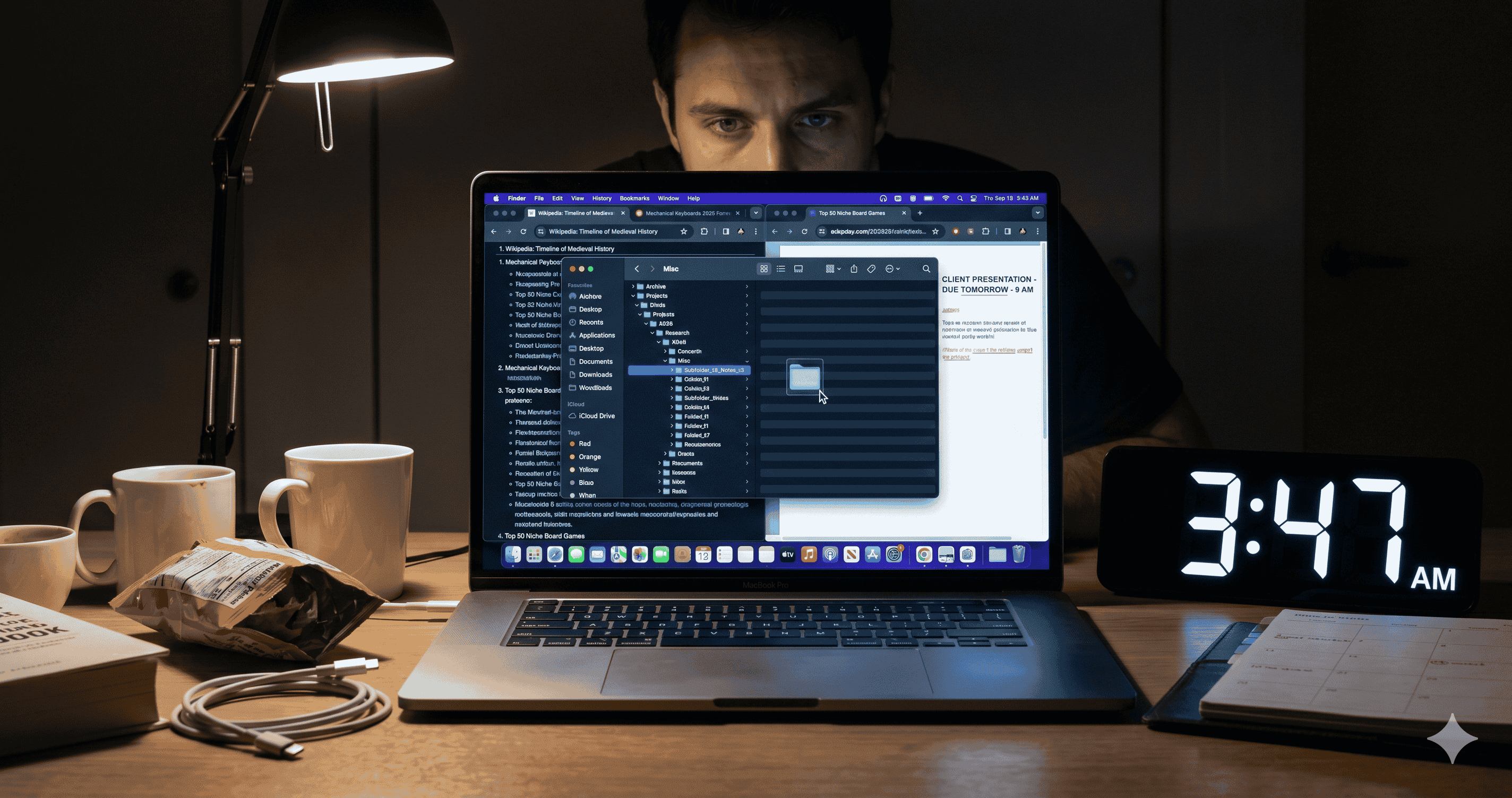
You sat down at 9 AM to write the report due Friday. It is now 1 PM. You have cleaned your inbox, renamed a folder, color-coded a Notion database that did not need color-coding, and read a forty-page Wikipedia article on the history of the QWERTY keyboard. You feel weirdly satisfied. You also have not typed a single sentence of the actual report.
This is ADHD hyperfocus on the wrong things. It is not a willpower failure. It is a feature of the same nervous system that lets you crush the right thing for six hours straight on a good day. The trick is to spot it earlier, route it gently, and not burn the rest of the afternoon shaming yourself for it.
What ADHD hyperfocus on the wrong things actually is
ADHD hyperfocus on the wrong things is the same neurological state as productive hyperfocus, just pointed at a low-priority task. The lock-in is real, the time loss is real, the productivity is illusory.
ADHD attention is not deficient so much as differently allocated. It clings hard to whatever signal is loudest right now: novelty, immediate feedback, a small win every few seconds. Cleaning an inbox is a perfect fit, because every archived email is a tiny dopamine ping. Writing a hard report has a delayed payoff that the ADHD brain registers as “boring” until paragraph three, which you never reach because the inbox finished first.
The result is hours of intense, satisfying work on something that was not on your list.
Why your ADHD brain picks the wrong target
Because the ADHD brain runs on interest and novelty, not deadlines. The “wrong” task is just the one with the highest immediate dopamine return; the real task usually has a delayed payoff and a higher activation cost.
A few pieces of this are well documented:
- ADHD is associated with what clinicians call an interest-based nervous system. Attention flows to whatever is new, urgent, challenging, or personally interesting, not necessarily to whatever the calendar says is most important.
- Time discounting is steeper in ADHD. A reward now feels much larger than a reward Friday, even when the Friday reward is objectively bigger. The deadline is not psychologically present yet.
- The environment is the silent collaborator. An open Slack tab, an inbox full of unread, a browser with seventeen “later” tabs: each is a high-novelty target sitting right next to the boring one.
None of this is a moral problem. It is a wiring difference plus a hostile environment. Most wrong-thing hyperfocus is the brain doing exactly what brains do, in a setup that makes the wrong choice the path of least resistance.
How to catch ADHD hyperfocus on wrong things earlier
The single most effective thing is to make time visible while you work. ADHD brains lose track of elapsed minutes in any lock-in state, including the unproductive ones, so a glanceable timer or live activity readout is the early-warning system.
A few practices that actually help:
- A real-time activity readout in your peripheral vision. Not a daily report; something you can glance at and read Finder, 47 min during what felt like a quick tidy. The number alone, with no nag attached, is usually enough to break the spell. (See the time blindness ADHD app post for the long version.)
- One anchor question, every 30 minutes. “Is this the task I sat down for?” Set a soft alarm. The question takes three seconds. The answer is occasionally life-changing.
- A paper sticky note with the day’s one real task. Stuck on the bezel of your monitor. ADHD brains forget the goal during the lock-in. The executive function that retrieves it from memory is the thing that just went offline; the sticky bypasses retrieval.
- No shame loops. If you notice you have spent three hours on the wrong thing, the temptation is to spiral. Spiraling burns the next hour too. Notice, save your work, redirect.
What to do the moment you notice
Do not punish the lock-in, bridge from it. ADHD hyperfocus is hard to start and surprisingly easy to redirect during the state, before it ends in a crash.
A working sequence:
- Save what you were doing. Even if it was off-task, the work is real. Closing it unsaved kicks off guilt that kills the redirect.
- Move your body for two minutes. Stand up. Water. Walk to a different room. Hyperfocus has a physical anchor, and breaking the posture loosens it.
- Open the real task and read the last sentence you wrote. Do not try to produce. Just read.
- Micro-commit. “I will just write the next sentence.” Once the cursor is moving, the ADHD brain often re-locks, on the right target this time.
You are not fighting your wiring here. You are using it.
Quick facts
- The CDC estimates around 6% of U.S. adults are diagnosed with ADHD (CDC), and hyperfocus is one of the most consistently self-reported features in adult ADHD, even though it is not part of the formal diagnostic criteria.
- Research summarized by the American Psychological Association suggests task-switching can cost up to 40% of someone’s productive time (APA on multitasking), a tax that compounds when the task you keep switching to is not the right one to begin with.
- Are You Productive runs at under 1% CPU and ~20 MB on disk, small enough to leave on all day as a passive readout without joining the problem.
The tool layer, kept small
Once time is visible, the rest of the tool stack stays minimal. The honest list for managing ADHD hyperfocus on the wrong things:
- A real-time activity tracker for your computer. Glanceable. No nags.
- A paper notebook for the parking-lot ideas your brain coughs up during a lock-in.
- A soft 30-minute alarm for the anchor question.
- An app or site blocker for your worst two wrong-thing magnets, scheduled during deep work.
That is the whole list. Most ADHD productivity apps are reskinned versions of these four primitives, and many of them add notification loops that compete for the same attention you are trying to protect.
Full disclosure: I built one of them. Are You Productive is a free, private, lightweight macOS app that handles the real-time readout piece. It sits in your menu bar, shows you exactly which app or website is currently eating your time, tags activity as productive or unproductive based on your own roles, sends nothing off your machine, and never nags. I built Are You Productive because the trackers I tried either took a week to show me the four hours that vanished into Discord, or shamed me about it on the way. The number, on its own, was the intervention I needed.
If you want the broader environment-and-friction playbook beneath this one, the why can’t I focus on work post is the cross-cluster version, written for the same problem from the non-ADHD angle.
The bottom line
ADHD hyperfocus on the wrong things is not a character flaw and is not curable. It is the same engine that produces your best four-hour work sprints, just pointed at the wrong target. Catching it earlier is mostly a visibility problem: make time legible, ask one anchor question, redirect gently when you notice.
Pick the visibility tool today. The redirect habit will catch up to it on its own.
This post was written with the help of AI.