Short answer. Digital addiction is the compulsive, hard-to-stop use of phones, social apps, and short-video platforms — engineered by their designers, not invented by you. You don’t fix it with willpower or shame. You make the pattern visible (real-time, ambient time tracking), then make the worst venues a little harder to reach. Are You Productive is the calm, private Mac app I built for the first half of that.
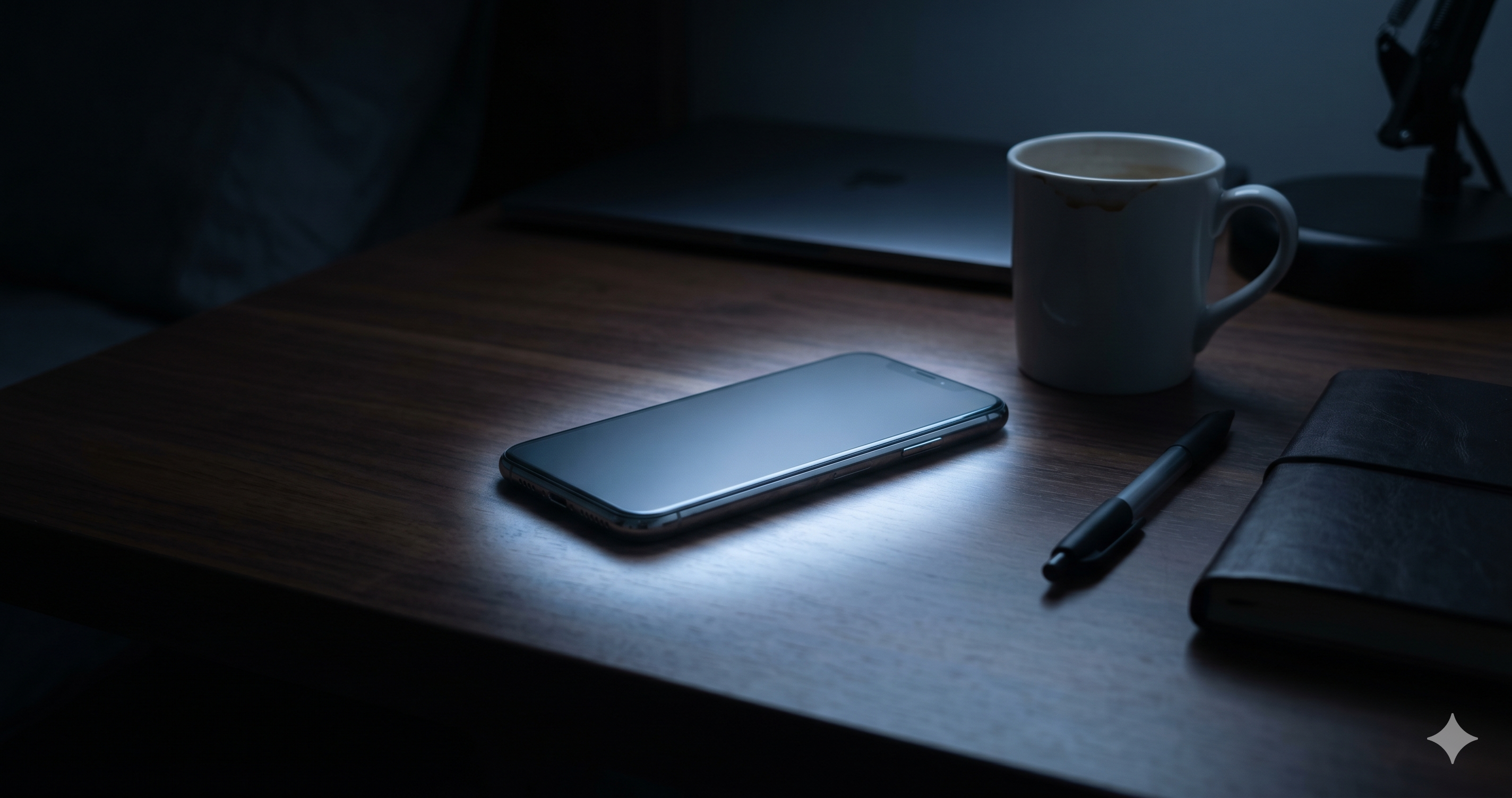
It’s 11:54 p.m. The room is dark except for the phone. You meant to check one notification at 10. You “rested” for a few minutes on the couch. Then a video. Then a comment thread. Then a different app, because the first one ran out. Now your eyes ache, your back hurts, and the day you wanted to have ended somewhere around 9 without you noticing.
You search “digital addiction” at midnight, find a few articles warning you about dopamine, scroll past them, and go to bed feeling slightly worse. Tomorrow you’ll do it again — not because you want to, but because the pull is genuinely stronger than your tired brain at the end of a long day.
This is the longer, calmer write-up I wish I’d read on one of those nights. No shame. No 30-day detox. Just an honest read on what’s happening and a small set of moves that have worked for me and for the people who use the app I built.
What digital addiction actually is
The phrase gets thrown around so loosely that it’s worth being specific. Digital addiction, as researchers use it, refers to a compulsive pattern of using digital technology — phones, social media, games, streaming, short-video apps — that is hard to stop, persists in the face of negative consequences, and shows the loop signatures of other behavioral addictions: tolerance (needing more to feel the same), withdrawal-like irritability, and a gap between intended use and actual use.
It is not a moral failing. It is a predictable, almost mechanical outcome of spending eight to twelve hours a day inside products whose business models depend on you not being able to put them down. Variable rewards (Skinner-box style), infinite scroll (no natural stopping point), autoplay (no decision moment between videos), social notifications (artificial urgency), and algorithmic feeds tuned on your past behavior — all of it is engineered. The same techniques that make slot machines profitable have been quietly imported into the apps you use to “relax”.
The World Health Organization has formally recognized one slice of this — gaming disorder — in the ICD-11. The broader category of “internet use disorder” is still debated in the clinical literature, but the experience is universal enough that nearly everyone reading this knows the feeling: I sat down for five minutes and lost an hour, and I didn’t even enjoy it.
That gap — between intended use and actual use, between five minutes and an hour, between “I’ll just check” and the thing that happens next — is the practical definition of digital addiction for the purposes of this post. If your hours and your intentions don’t agree, you’re somewhere on the spectrum, and you do not have to be in the clinical end of it for this to be worth fixing.
Why willpower lectures don’t work
If discipline alone could solve digital addiction, you would have solved it by now. You read books. You set rules. You put the phone in the drawer for half a Saturday. The pull came back, the rules softened, and a Tuesday evening looked the same as it did before.
This isn’t because you are broken. It’s because willpower is a slow, high-effort, conscious system being asked to override a fast, low-effort, unconscious loop running thousands of times a day. The math doesn’t work. The phone wins by reps.
There’s a second reason willpower advice quietly fails: it requires you to notice you’re inside the loop, and the loop is specifically engineered to suppress that noticing. Autoplay removes the natural pause between videos. Infinite scroll removes the bottom of the page. Algorithmic feeds remove the moment of “okay, I’ve seen everything new”. Push notifications hijack the orienting reflex. By the time the decide-to-stop moment arrives, you’ve already been gone for forty minutes, and the willpower budget you were going to spend on the decision has been spent on a hundred micro-decisions that never reached conscious awareness.
The reason most digital-addiction advice doesn’t stick is that it attacks the output (your behavior) instead of the input (your awareness). Reverse the order and the problem becomes much smaller.
Quick facts
- The average American adult spends over 4 hours a day on their smartphone, and the figure is rising year over year — most of it not on calls or productive apps.
- The World Health Organization has recognized gaming disorder as a clinical condition in the ICD-11, describing it in language that closely tracks behavioral-addiction criteria like impaired control and continued use despite harm.
- A 2017 study in the Journal of the Association for Consumer Research found that the mere presence of a smartphone — face-down, silenced — measurably reduced available cognitive capacity, even when participants weren’t using it.
- Are You Productive runs at under 1% CPU and ~20 MB on disk, so the awareness layer doesn’t itself become another tab to manage.
The two-part fix: visibility, then friction
Almost everything that has ever worked for me, or for the people who write to me about the app, reduces to two moves done in this exact order.
First, make the pattern visible. You cannot change a behavior you can’t see, and digital addiction’s signature trick is invisibility. The first job is to install a real-time, ambient readout of where your hours are actually going. Not a Sunday-night PDF. Not a weekly summary. A glanceable number, right now, telling you that you have been on Instagram for 23 minutes during what your brain is logging as “a quick break”. The number alone, with no nagging, fixes a surprising amount of the behavior — because the loop relied on you not seeing it.
Second, add friction at the worst venue. Pick the single app or
site that surprised you most in week one of visibility. Not all of
them. One. Then make it a little harder to reach: log out on every
device, delete the icon, route the URL to 0.0.0.0 in your hosts
file, install a blocker, move the app to a folder three swipes deep,
turn off notifications system-wide for it. You aren’t trying to make
it impossible — that triggers the rebound. You’re adding two seconds
of conscious choice between the urge and the action, which is enough
for the slow system to wake up and weigh in.
That’s it. Visibility, then friction, in that order. Reverse them and you’ll block apps you didn’t actually need to block while leaving the real time-eaters untouched. Skip visibility and you’ll keep treating the symptoms.
A one-week protocol for digital addiction that doesn’t suck
If you want a concrete plan to start tonight, here it is. It’s small on purpose. Big detox plans fail because they front-load all the willpower; small protocols work because they don’t.
Day 1. Install something that gives you a real-time, per-app elapsed-time readout. (I built Are You Productive for this on Mac because nothing else did the simple thing simply, but use whatever fits — the principle, not the product, is what matters.) Don’t change a single habit today. Just look at the number a few times.
Days 2–3. Keep looking. Don’t react. Notice especially the apps where the felt time and the real time disagree the most. Those are your hotspots. They are usually not the apps you’d guess. For most people they are some mix of YouTube, TikTok, Instagram, Reddit, Twitter/X, Messenger, Discord, and the news.
Day 4. Pick one hotspot. Add friction. Log out on every device. Delete the icon from your home screen. Turn off all of its notifications. If it’s a website, install a blocker or edit your hosts file. The bar is “two extra seconds of conscious choice”, not “impossible”.
Days 5–7. Keep watching the number. Notice the rebound — your brain will try to spend the missing time on the next-worst app. That’s fine. Don’t try to block that one yet. The data is the point.
Week 2. If week one feels stable, pick the second hotspot and repeat. If week one was hard, repeat week one. There is no schedule. You are not behind.
This protocol works because it respects how the brain actually changes behavior — small evidence, small moves, no shame, no big bang. It does not work in seven days the way a marketing page would promise. It works over weeks, quietly, and the changes stick because they were small enough not to provoke a rebound.
What to look for in a tool, and what to avoid
Not every “digital wellness” app helps. Some of them are part of the problem dressed up in concerned-parent language. The pattern to watch for is whether the tool adds to your daily emotional load or subtracts from it.
Properties that help with digital addiction:
- Real-time, ambient feedback. Menu-bar level on Mac, widget-level on phone. The number is the intervention. Daily reports are too late.
- Per-app and per-site granularity. “4 hours of Chrome” is meaningless. “82 minutes of YouTube, 41 minutes of Reddit, 12 minutes of the doc” is.
- Calm UI. No gamification. No streaks. No medals. No guilt-coloured graphs. The number does the talking.
- Local-first and private. Your activity log is intimate data. Cloud trackers route it to a server you don’t control, which is a lot of trust to extend for what amounts to a personal feedback loop.
- Lightweight. It runs all day. If it spins your fan or eats your RAM, it’s joined the problem.
Properties to avoid:
- Push notifications urging you to “stay focused”. Now you’re being interrupted about being interrupted.
- Productivity scores and streaks. They turn the tool into another app you have to feed, and they punish bad days, which is when you most need the tool to be neutral.
- Cloud accounts and “team dashboards”. You are not a billable resource. You are a person trying to get an evening back.
- Ad-supported “free” trackers. The activity log is the product.
A useful sanity check: does the app ask you to engage with it more, or less, over time? The right tool wants to disappear into the background once it’s done its job. The wrong tool wants daily attention forever.
If your problem is more about not being able to start the work in the first place, rather than not being able to stop the scrolling, the piece on why can’t I focus on work is a better starting point. If the loss-of-time feeling rings the loudest bell, the time blindness ADHD app piece goes deeper on the awareness side.
The honest bottom line
Digital addiction is real, it is not a character flaw, and you cannot discipline your way out of it because the products you’re using were built by very smart people whose job was to make sure you couldn’t. That is the bad news.
The good news is that you don’t need to. The behavior collapses quickly once you can see it, because the engineering relied on you not seeing it. Install a quiet, real-time readout. Look at it for a week without reacting. Pick one hotspot. Add a little friction. Watch the rebound. Repeat. That is the whole protocol. There is no detox retreat, no app subscription, no productivity religion to convert to.
The version of Are You Productive sitting in my menu bar right now is not the reason I have my evenings back. It is the reason I can see that I have my evenings back, which turned out to be enough. If you try Are You Productive or anything like it, please use it the boring way: glance, notice, adjust, forget. The less the tool asks of you, the more day it gives back.
Now close this tab. The loop is still running. Go install something quiet that lets you watch it.
This post was written with the help of AI.