Short answer. You can learn how to focus with ADHD without medication, but the work is environmental, not motivational. Reduce the inputs (notifications, tabs, phone), make time visible (a calm real-time tracker), and protect one short deep-work block a day. Medication is powerful when available; this is the rest of the toolkit, and it carries most of the weight either way.
You have ADHD, you can’t or won’t take stimulants right now, and the advice you keep getting is some version of try harder. Maybe a clinician hasn’t prescribed yet. Maybe the side effects weren’t worth it. Maybe you’re pregnant, breastfeeding, or in recovery. Maybe meds just aren’t part of your plan. Whatever the reason, the internet has decided that medication and productivity advice written for neurotypical office workers are the only two answers, and neither one is working for you.
This is the calmer middle path. It’s what I do on the days my prescription isn’t in play, and what works for the friends of mine who never had one.
Why “just focus harder” is the wrong question
The standard ADHD focus advice for adults (Pomodoro, time-block, write a to-do list) is built for a brain that has a clear internal sense of time and an okay handle on salience. The ADHD brain doesn’t have either of those by default. It’s not that you can’t focus. It’s that your attention picks the wrong target, your sense of elapsed time runs slow, and the environment around you was engineered by people whose bonuses depend on hijacking exactly those weak spots.
So when you ask how to focus with ADHD without medication, the most useful answer isn’t “use this app” or “do this technique”. It’s fix the environment first, because the environment is doing eighty percent of the damage. You can run any technique you want on a noisy environment and it will fail. You can run almost any technique on a quiet environment and something will stick.
This is the order of operations almost nobody teaches:
- Reduce inputs.
- Make time visible.
- Protect one short block a day.
- Sleep, exercise, food.
- Then pick a technique.
We’ll walk each one.
How to focus with ADHD without medication: the four levers that work
1. Reduce the inputs
The hardest part of ADHD focus is the interruption recovery tax. Every time something pings, you lose fifteen to twenty-five minutes of re-entry before you’re back where you were, and the ADHD brain pays that tax more times per hour than a neurotypical one.
The fix is to drop the number of interruptions, not to get better at recovering from them.
- Turn off all notification sounds and badges on your laptop and phone. Not “Do Not Disturb”. Fully off, system-wide, for everything except calendar and phone calls from a tiny favorites list.
- Log out of every social media site in the browser you work in. Not blocked, just logged out. The login wall is enough friction to break the autopilot reach.
- Put the phone in another room. Twenty feet of physical distance is a feature.
- One screen, one window. The second monitor is a distraction tax on ADHD focus disguised as a productivity tool.
This is the closest thing to a free lunch in the entire “how to focus with ADHD without medication” playbook. None of it requires willpower in the moment, because you do the work once.
2. Make time visible
Time blindness is the part of ADHD that quietly steals more hours than anyone realizes. (If this is new to you, the time blindness ADHD app post is the long version.) The ADHD brain doesn’t feel an hour passing inside a YouTube rabbit hole. It feels like ninety seconds.
The fix is to externalize time so your eyes can do the job your internal clock can’t. A real timer in your line of sight. A menu-bar readout that shows Spotify, 14 min during what felt like a quick song change. A glance, a number, no nagging.
Critically: don’t use a tracker that gamifies, ranks, or notifies. ADHD brains respond badly to streak systems and shame nudges. The number alone, calmly available, is the intervention.
3. Protect one short block a day
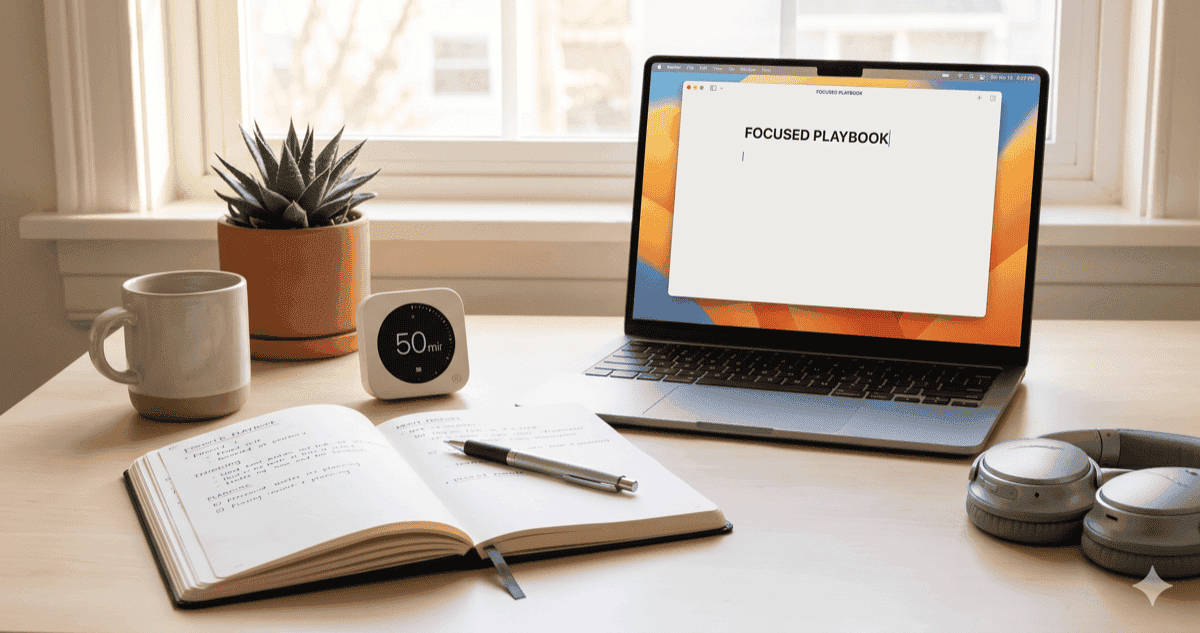
Ninety-minute deep-work sessions are aspirational for most ADHD brains on most days. Don’t start there. Start with one twenty-five minute block, in the morning, before any input loop has hijacked you. Headphones on, phone in the next room, every notification silent, one app open.
If twenty-five is too long today, do fifteen. If fifteen is too long, do ten. The length is negotiable. The daily-ness isn’t. Twenty short sessions a month outperforms one heroic four-hour session you’ll crash from.
4. The boring stuff that still works
Sleep, exercise, food. I know. But on the days you’re trying to focus with ADHD without medication, these stop being optional. They’re the only baseline support your nervous system gets.
- Sleep. Even thirty minutes less than your real number tanks ADHD focus the next day. Track it for one week and you’ll see it.
- Exercise. Twenty minutes of anything that elevates your heart rate in the morning measurably improves executive function for the next several hours.
- Food. Protein at breakfast. Avoid the late-morning sugar crash that takes your already-shaky focus with it.
These are the levers everyone rolls their eyes at because they’re unsexy. They are also the ones most consistently supported by the research.
Quick facts
- The CDC estimates around 6% of U.S. adults are diagnosed with ADHD, and many manage symptoms with non-pharmacological strategies (CDC).
- A meta-analysis of aerobic exercise interventions for ADHD found measurable improvements in executive function and attention, independent of medication (NIH/PMC).
- Research summarized by the American Psychological Association suggests task-switching can cost up to 40% of someone’s productive time (APA on multitasking), a tax ADHD brains pay disproportionately.
- Are You Productive runs at under 1% CPU and ~20 MB on disk, small enough to leave on all day without joining the problem.
The tool layer, last and smallest
Once the environment is quieter and the time-cue is back, then tools start to help. The honest tool list for learning how to focus with ADHD without medication is short:
- A timer. Any timer. A real one, in your eyeline.
- A real-time activity tracker for your computer. Not a weekly report; a glanceable one.
- A site or app blocker for your worst two distractions, scheduled during your deep-work block.
- A paper notebook for the parking lot of I need to look at this later thoughts that ADHD brains generate during focus.
That’s the whole list. Productivity apps for ADHD are mostly re-skinned versions of these four primitives, and most of them add notification loops the ADHD brain doesn’t need.
Full disclosure: I built one of these. Are You Productive is a free, private, lightweight macOS app that handles the real-time tracker piece. It sits in your menu bar, tags apps as productive, neutral, or unproductive based on roles you pick once during onboarding, sends nothing off your machine, and never nags. I wrote it because the alternatives (RescueTime, Rize, Mac Screen Time) were too cloud-y, too heavy, too gamified, or too delayed for an ADHD brain that needs the number now. Use it, don’t use it. The environment work above carries most of the weight either way.
If you want the broader friction-and-visibility playbook beneath this one, the why can’t I focus on work post is the cross-cluster version, written for the same problem from the non-ADHD angle.
The bottom line
Learning how to focus with ADHD without medication is mostly unglamorous infrastructure work: quieter notifications, visible time, one short protected block, the boring health basics. It is not a substitute for clinical treatment when clinical treatment is indicated. It is, however, the rest of the toolkit. On the days the prescription isn’t in play, it’s most of what you have. The good news is it’s most of what you need.
Start with the notifications today. The rest can wait until Saturday.
This post was written with the help of AI.